Most companies still approach AI with a familiar playbook: select a platform, run a pilot, train users, measure adoption, and scale licenses.
That playbook worked reasonably well when software waited for a person to tell it what to do. AI changes the premise. It can interpret information, recommend decisions, generate work, and increasingly act across systems. The question is no longer only, “Does the tool work?” It is, “How should work operate when software can participate in judgment and execution?”
That is an operating-model question.
A rollout changes the tool. AI changes the work.
A conventional software rollout usually digitizes a defined process. The roles, approvals, decision rights, and accountability remain mostly intact. Employees learn a new interface, but the organization still knows who owns the work and how exceptions move.
AI adoption is different because the technology enters the workflow itself. It may draft the response, classify the case, summarize the evidence, recommend the next action, or initiate a transaction. Each capability changes the boundary between human and machine.
Leaders therefore have to answer questions a normal deployment plan rarely resolves:
- Which decisions may the AI support, and which may it make?
- What data and business context may it use?
- When must a person review or approve its work?
- Who owns an incorrect outcome?
- How is the action logged, monitored, and reversed?
- What happens when confidence is low or the situation is unfamiliar?
If those answers are missing, a technically successful pilot can still fail operationally.
The five layers of the AI operating model
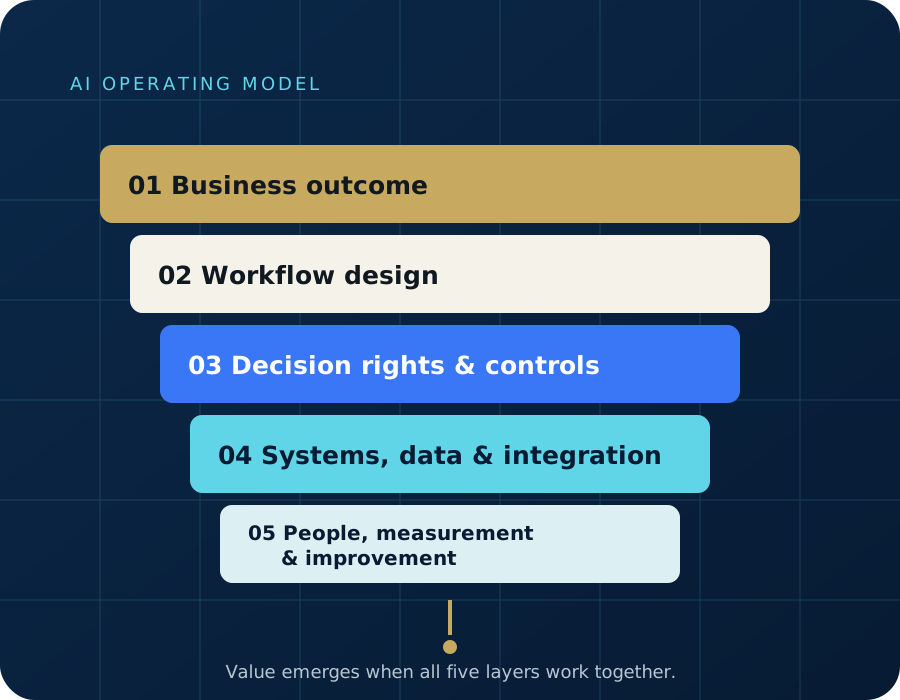
I use five layers to separate a promising demonstration from a dependable business capability.
1. Business outcome
Begin with the result the workflow must improve: cycle time, conversion, service quality, forecast accuracy, cost, risk, or capacity. “Use generative AI” is not an outcome.
The metric must have an owner, a baseline, and a time horizon. Without them, teams end up measuring model activity rather than business value.
2. Workflow design
Map the work before choosing where AI belongs. Identify inputs, decisions, handoffs, exceptions, and delays. Then decide which steps should be assisted, automated, or left entirely to people.
McKinsey’s 2025 global AI research identifies workflow redesign as one of the practices associated with organizations reporting greater value from AI.[1] Another McKinsey survey found that organizations were beginning to redesign workflows, elevate governance, and place senior leaders in critical AI roles as they pursued bottom-line impact.[2]
The practical lesson is simple: adding AI to a broken workflow usually creates a faster broken workflow.
3. Decision rights and controls
Define the AI system’s operating boundary in plain language:
- What may it observe?
- What may it recommend?
- What may it execute?
- What requires approval?
- What must always be escalated?
NIST’s AI Risk Management Framework treats governance as a cross-cutting function and organizes risk work around govern, map, measure, and manage.[3] That structure is useful because governance is not a final compliance gate. It must influence the workflow from design through operation.
Controls should match the consequence of failure. Drafting an internal summary may require sampling and feedback. Approving a financial transaction demands identity, authorization, policy checks, auditability, and a reliable reversal path.
4. Systems, data, and integration
AI does not create operating value in isolation. It needs current context from enterprise systems and a controlled way to return work to those systems.
For every integration, specify:
- The system of record
- The minimum required data
- Permission boundaries
- Data freshness
- Failure behavior
- Audit logging
- Ownership of the integration
This is often the hidden work. A model can produce an impressive answer in a sandbox while the production workflow fails because customer data is stale, permissions are too broad, or no one owns the handoff.
5. People, measurement, and improvement
AI changes roles even when it does not remove them. People may move from producing every output to setting intent, reviewing exceptions, coaching the system, or managing outcomes across a larger volume of work.
That shift requires more than training on prompts. Teams need clarity about accountability, incentives, escalation, and what good judgment now looks like.
The measurement model should include:
- Business outcome
- Quality and reliability
- Human intervention rate
- Exception and escalation rate
- Cost per completed outcome
- User and customer impact
- Control effectiveness
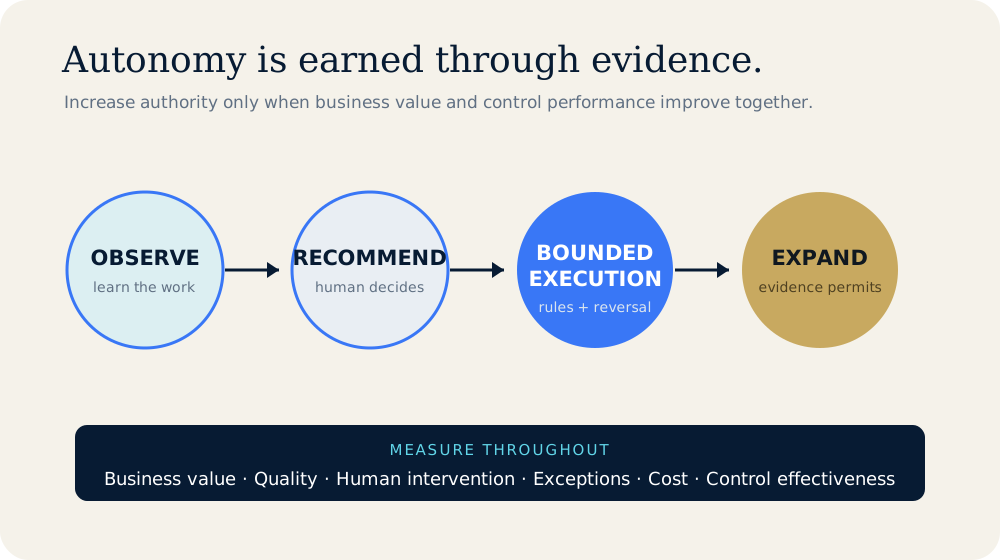
A workflow should earn greater autonomy through evidence. Start with observation, move to recommendations, permit bounded execution, and expand only when the results justify it.
Use a workflow contract, not a vague use case
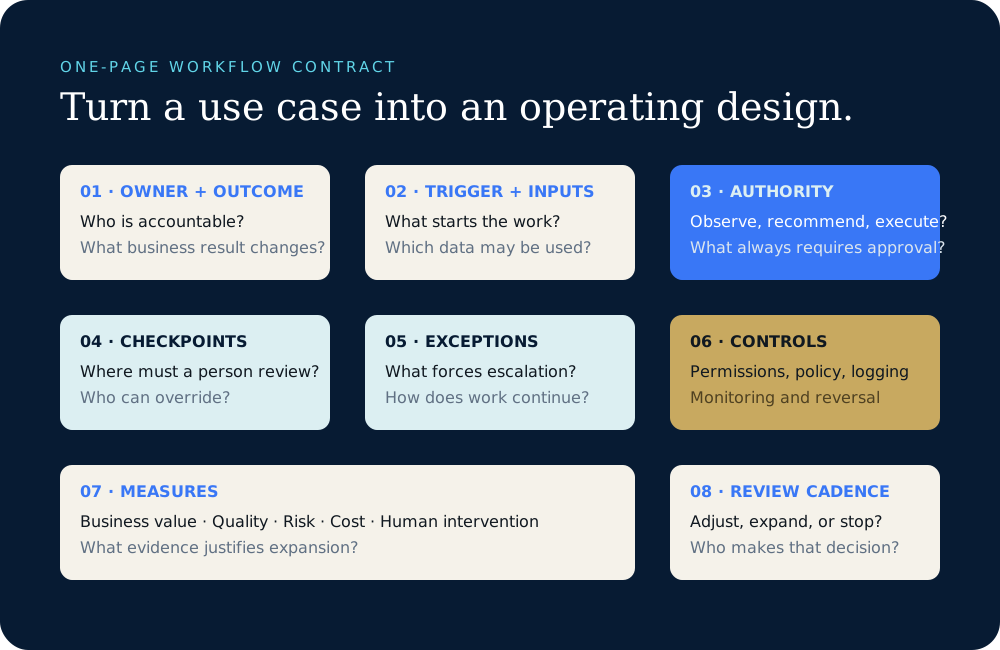
Before a pilot begins, write a one-page workflow contract. It should name:
- Owner: the executive accountable for the business outcome.
- Operator: the team responsible for daily performance.
- Trigger: the event that starts the workflow.
- Inputs: the approved data and systems the AI may access.
- Authority: what the AI may observe, recommend, or execute.
- Human checkpoints: where review or approval is mandatory.
- Exceptions: the conditions that force escalation.
- Controls: permissions, policies, monitoring, and reversal.
- Measures: business, quality, risk, and adoption metrics.
- Review cadence: when leaders decide whether to adjust, expand, or stop.
This contract turns “AI for customer service” into an operating design. It also creates a shared language for business, technology, risk, legal, and frontline teams.
A practical example: resolving a customer request
Imagine an AI assistant supporting a complex customer-service team.
A software-rollout mindset asks whether the assistant can summarize the case and generate a response.
An operating-model mindset asks:
- Which requests can be resolved automatically?
- Which policies must be checked before action?
- Which customer segments or financial thresholds require approval?
- Can the system update the CRM, issue a credit, or only recommend those actions?
- How is the customer informed that AI assisted the interaction?
- What evidence is preserved for audit and coaching?
- Who reviews repeated failure patterns?
The model may be only one component. The full capability includes identity, permissions, policy retrieval, workflow orchestration, monitoring, escalation, and human judgment.
That is why AI adoption cannot belong solely to IT. Technology enables the capability, but business leadership owns the work.
The executive agenda
Leaders do not need one grand AI transformation program. They need a disciplined portfolio of controlled workflow experiments.
For each candidate workflow:
- Name the business owner and measurable outcome.
- Map the current workflow and its failure points.
- Set the boundary between assistance and action.
- Connect only the data and systems required.
- Design human checkpoints and exception paths.
- Run in observation or recommendation mode first.
- Measure operational value and control performance.
- Expand authority only when evidence supports it.
The result is slower than announcing an enterprise AI platform and faster than cleaning up an uncontrolled deployment.
The real shift
Software rollouts ask people to adopt a tool.
AI adoption asks the organization to redesign how work is assigned, performed, reviewed, measured, and governed.
The companies that understand this will not be defined by how many AI licenses they purchased. They will be defined by how deliberately they changed the operating system of the business, one trusted workflow at a time.
Executive checklist
Before approving an AI initiative, ask:
- Is there a named business outcome and owner?
- Has the current workflow been mapped?
- Are decision rights explicit?
- Are system and data permissions bounded?
- Is there a human escalation path?
- Can every consequential action be audited and reversed?
- Are quality, risk, cost, and business value measured together?
- Is increased autonomy earned through evidence?
If the answer to several of these is no, you do not yet have an AI deployment. You have a demonstration looking for an operating model.
Sources

About Kamaraj
Hands-on AI strategist and enterprise technology advisor helping leaders turn AI possibility into operating business value.