I learned the most about transformation at customer sites.
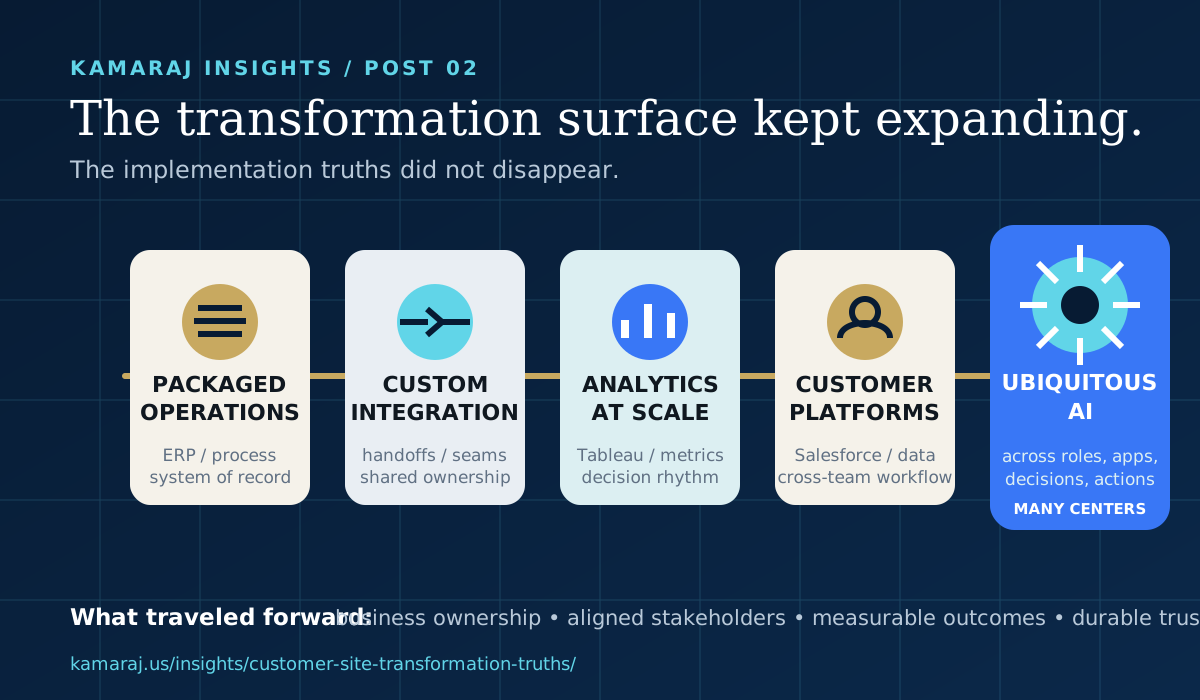
The technology changed over the years. SAP ERP brought core operations into an integrated system. Custom integrations connected applications that were never designed to work together. Tableau helped leaders see the business differently. Salesforce connected customer data, teams, and workflows around a shared operating picture.
Each platform opened a new possibility. None of them transformed a business by itself.
The work succeeded when people made a small set of hard decisions early: which operation mattered, what outcome they expected, who would lead the change, who needed a seat at the table, and how the solution would remain trusted and useful after the launch team left.
Those implementation truths still apply to AI. The difference is reach. AI will not stay inside one application or one department. It can appear wherever people interpret information, make a decision, create work, or act across systems.
That makes implementation discipline more important, not less.
Four technology eras, one recurring lesson
Packaged enterprise software gave organizations a standard process and a system of record. It also forced difficult conversations about how the business should operate.
Custom integrations exposed the seams. A process could look complete in one application and still fail at the handoff to finance, operations, a partner, or a customer. The interface was technical. The ownership problem was not.
Analytics platforms such as Tableau made performance visible. That visibility created value only when leaders agreed on the metric, trusted the data, and used the insight to make a decision.
Customer platforms such as Salesforce connected selling, service, marketing, and account management. The hardest work was rarely configuring a screen. It was agreeing on the customer process, data ownership, role boundaries, and expected behavior across teams.
Different technologies. Familiar implementation questions.
Five implementation truths that still apply to AI
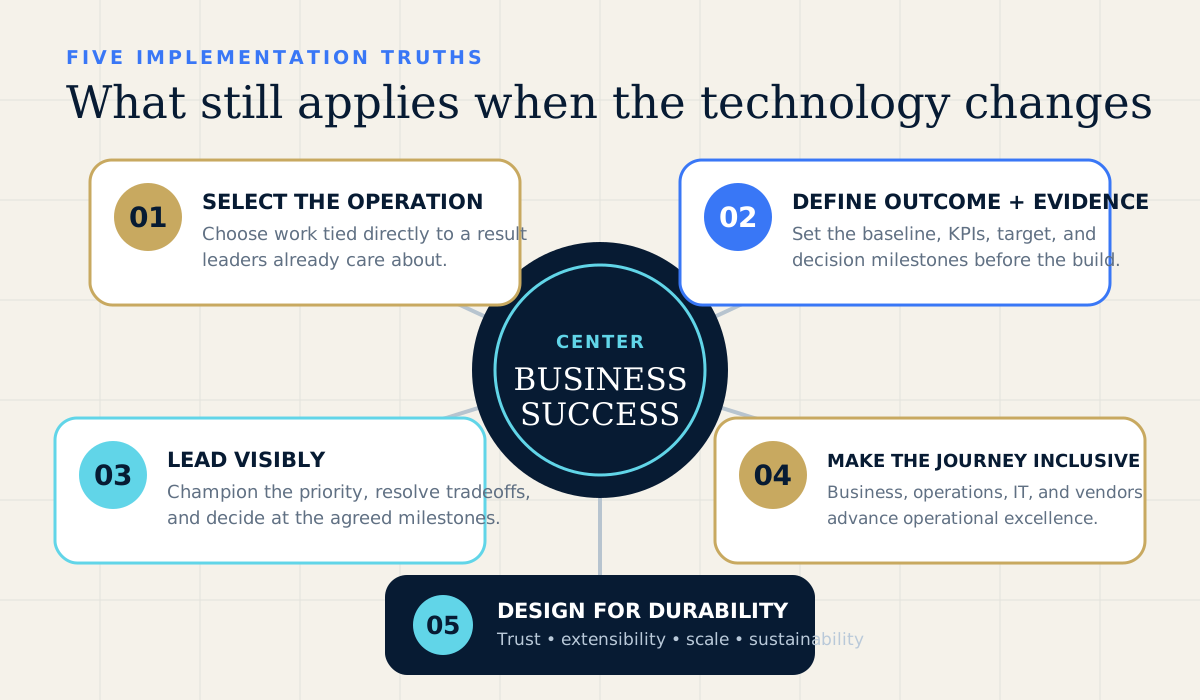
1. Select an operation that directly affects business success
A transformation needs a business reason strong enough to survive implementation friction.
The best starting point is a function or operation tied to a result leaders already care about: closing the books, fulfilling an order, resolving a service case, converting a qualified opportunity, reducing forecast error, improving asset uptime, or managing working capital.
A broad goal such as "use AI across the enterprise" does not tell a team what to change. A bounded operation does. It gives the program an owner, a workflow, a baseline, and a consequence if the work fails.
This was true for ERP, analytics, and CRM. It is even more important for AI because a model can produce an impressive output long before the organization has agreed on where that output belongs.
For AI, select the workflow before selecting the model. Name the business event that starts the work, the decision that must improve, and the person accountable for the result.
2. Define the outcome, KPIs, and decision milestones before implementation
Teams often agree on the technology before they agree on success.
That creates a predictable problem. The project measures activity: licenses assigned, users trained, dashboards created, prompts submitted, or agents deployed. None of those measures proves that the business operation improved.
The expected outcome should be plain enough for an executive and an operator to describe the same way. Then give it a baseline, target, time horizon, and a small set of quality and risk measures.
Milestones matter because transformation is a sequence of decisions, not a ceremonial go-live. At each stage, leaders should be able to decide whether to continue, correct, expand, or stop.
For an AI workflow, the scorecard may include cycle time, quality, exception rate, human intervention, cost per completed outcome, customer impact, and control performance. Model accuracy belongs on the scorecard, but it cannot be the whole scorecard.
3. Leadership must visibly champion the transformation
Executive sponsorship is not a name on a steering committee slide.
People watch what leaders ask about, what they fund, which tradeoffs they resolve, and whether they use the new operating process themselves. A leader who speaks about transformation but allows every function to preserve its old incentives sends a clear signal: the change is optional.
Visible leadership means naming the business outcome, protecting the priority, resolving ownership disputes, and making decisions at the agreed milestones. It also means acknowledging where the change creates real pressure for teams.
AI adds a new leadership responsibility. Leaders must define the acceptable boundary between assistance and action. They cannot delegate that boundary entirely to a vendor, a model team, or an innovation lab. The business owns the consequence.
4. Make transformation an inclusive journey toward operational excellence
I have rarely seen a durable transformation designed by one function alone.
Business leaders understand the outcome and policy. Operations teams know how work actually moves, including the exceptions that process diagrams politely ignore. IT understands systems, identity, data, integration, resilience, and support. Vendors bring product knowledge and implementation capacity.
Each group sees a different failure mode. Excluding one group does not remove that failure mode. It simply delays its discovery.
AI widens the table. Depending on the workflow, security, data, risk, legal, compliance, HR, and frontline employees may need to participate. Their role is not to add paperwork after the design is complete. Their knowledge shapes the operating boundary from the start.
The goal is not consensus on every detail. The goal is shared clarity about ownership, authority, handoffs, exceptions, and evidence.
5. Design for trust, extensibility, scale, and sustainability from the start
A solution can survive a demonstration and still fail in the business.
Trust begins with predictable behavior. People need to know which data the system used, what action it took, why a person must review something, and what happens when the system is uncertain or wrong.
Extensibility means the design can absorb a new process, data source, policy, or partner without being rebuilt from scratch.
Scale means more than transaction volume. It includes permissions, monitoring, support, cost, latency, exception handling, and the number of teams capable of operating the solution safely.
Sustainability means someone owns the capability after launch. Data changes. Policies change. Models change. Vendors change. The operating design needs a review cadence, support model, funding path, and a way to retire what no longer works.
NIST's Generative AI Profile treats risk management as work that spans the AI lifecycle and the business processes that use AI.[2] That is the right posture. Trust cannot be added as a final approval step. It has to be designed into the workflow, integration, measurement, and daily operation.
What changes when AI becomes ubiquitous
The 2025 Stanford AI Index reported that 78 percent of organizations used AI in 2024, up from 55 percent the year before.[1] The exact rate will keep moving. The implementation implication is already clear: AI is becoming a general capability inside many products, roles, and workflows rather than a destination system used by one specialist team.
That ubiquity changes transformation in four ways.
First, the entry points multiply. AI may arrive through a CRM feature, an analytics tool, an ERP workflow, a custom application, a service platform, or an employee's browser. A central program will not see every experiment.
Second, actions can cross system boundaries. An AI assistant may summarize information in one system, recommend a decision using data from another, and initiate work in a third. Integration design becomes authority design.
Third, change becomes continuous. Models, prompts, policies, data, and vendor capabilities will evolve after launch. A one-time training and adoption plan is not enough.
Fourth, trust becomes operational. Employees and customers experience AI through the quality of a recommendation, the fairness of a decision, the clarity of an explanation, and the speed of a human response when something goes wrong.

The old implementation model often had a center: one ERP program, one analytics platform, one CRM transformation. Ubiquitous AI has many centers. The discipline therefore has to move closer to the workflow.
Every material AI workflow needs a named owner, explicit authority, bounded data access, human checkpoints, measurable outcomes, and a decision cadence. Central governance should set common rules and infrastructure. Business and operations teams should own the use of AI inside the work.
A practical transformation brief
Before approving an AI initiative, I would ask a team to complete one page:
- Business operation: Which function or workflow directly affects business success?
- Expected outcome: What result should improve, from what baseline, by when?
- Business owner: Which leader will champion the change and resolve tradeoffs?
- Participants: Which business, operations, IT, risk, data, frontline, and vendor roles must shape the design?
- Operating boundary: What may the AI observe, recommend, create, or execute?
- Human checkpoints: Which decisions require review, approval, or escalation?
- Measures: Which value, quality, risk, cost, and adoption KPIs will guide decisions?
- Milestones: When will leaders continue, correct, expand, or stop?
- Durability: How will the capability remain trusted, extensible, scalable, and supportable?
If the team cannot answer these questions together, the problem is not a missing model feature. The transformation is not yet designed.
The lesson that travels forward
Business applications, custom integrations, and AI solve different problems. I would not pretend they are the same technology or that every implementation follows one formula.
But decades at customer sites taught me this: business transformation becomes real only when technology, operations, leadership, and measurement converge around a result people are prepared to own.
AI raises the ceiling. It also increases the number of places where a weak decision can travel quickly.
Choose the operation carefully. Define the outcome before the build. Ask leaders to champion the change in public and in decisions. Make transformation an inclusive journey toward operational excellence. Design trust and durability into the first version.
Those truths outlast the platform. They will matter even more when AI is everywhere.
Executive checklist
- Is the initiative attached to an operation that directly affects business success?
- Are the expected outcome, baseline, KPIs, and decision milestones explicit?
- Is a business leader visibly championing the change and resolving tradeoffs?
- Are business functions, operations, IT, frontline teams, and vendors participating early enough to shape the design?
- Are trust, extensibility, scale, support, and sustainability part of the first architecture?
- Is the AI operating boundary clear across data, decisions, actions, approvals, and exceptions?
- Can leaders continue, correct, expand, or stop based on evidence?
Sources

About Kamaraj
Hands-on AI strategist and enterprise technology advisor helping leaders turn AI possibility into operating business value.